Quick answer: When the freezer is cold but the fridge is warm, the cooling system is working — cold air just isn’t reaching the fresh-food compartment. The cause is almost always one of three things: a stuck damper assembly (most common), a failed evaporator fan motor, or a defrost system that has iced over the evaporator coil. Less common causes are blocked vents, a faulty thermistor, or a sealed-system refrigerant leak. Here is how to tell which one you have, in order of likelihood.
Why Only the Fridge Is Warm
On 95% of household refrigerators, only the freezer has an evaporator coil. The freezer is the source of cold; a fan called the evaporator fan blows cold air from the freezer up through a duct and into the fridge. A motorized flap called the damper opens and closes that duct to control how much cold air the fridge gets. If the fan stops, the damper jams, or the duct ices over, the freezer keeps making cold but the fridge stops receiving it. Diagnosing this fault is mostly about figuring out which link in that chain failed.
Diagnostic Checklist (Do This First)
| Check | Normal Result | Failed Result Points To |
|---|---|---|
| Listen at freezer door (press switch) | Steady fan whirr | Evaporator fan motor (#2) |
| Feel airflow at fridge vent | Strong cold breeze | Damper assembly (#1) |
| Remove freezer rear panel | Light frost only | Defrost system (#3) |
| Inspect interior vents | No food blocking | Air circulation (#4) |
| Thermistor resistance test | ~16 kΩ at 32°F | Sensor fault (#5) |
| Compressor running, no cooling at all on second evap | Both evap coils cold | Sealed-system leak (#6) |
1. Damper Assembly Stuck Closed ($150–$300)
This is the single most common cause — about 4 out of every 10 calls I take for "fridge warm, freezer cold." The damper is a motorized plastic flap at the top of the fridge compartment (sometimes side-mounted on French-door models). It opens and closes to regulate how much cold air enters from the freezer.
Two things kill dampers: the small stepper motor inside burns out, or condensation freezes the flap closed. On Samsung, LG, and Whirlpool French-door models, I see frozen dampers especially often because the duct is humid. Symptoms are unmistakable: freezer is rock-solid, fridge climbs to 50–55°F, and you feel no air movement at the vent inside the fridge.
Replacement runs $150–$300 in Denver depending on whether it is a simple manual damper (least common, $150) or a fully electronic damper with sensor and motor ($300). Most jobs take 45 minutes. GE has a useful technical page on the damper assembly if you want to see what the part looks like.
2. Evaporator Fan Motor ($180–$320)
The evaporator fan sits behind the rear wall of the freezer and pushes cold air across the coil and up into the fridge. When the fan stops or runs slow, the freezer can stay cold (frozen food is a thermal buffer) but the fridge warms up because no air is being moved. With the freezer door open, hold the door switch in by hand and listen carefully. A healthy fan whirrs steadily; a failing one grinds, chirps, or is silent.
Fans fail two ways: bearings dry up (loud grinding for 2–6 weeks before silence) or the motor windings short (sudden silence). Both require replacement. Total cost in Denver: $180–$320 installed, parts in hand on most service calls.
Tip: if you replace just the fan but the duct has ice in it, the new fan will fail again within months because it is fighting frozen airflow resistance. I always check for frost first — see cause #3.
3. Defrost System Failure ($150–$280)
The defrost system melts frost off the evaporator coil every 8–12 hours. It has three parts: the defrost heater (a metal rod next to the coil), the defrost thermostat (a safety switch), and the defrost timer or adaptive defrost board (controls when defrost runs). When any of those three parts fails, frost slowly builds up on the coil until it forms a solid block of ice that air can no longer pass through.
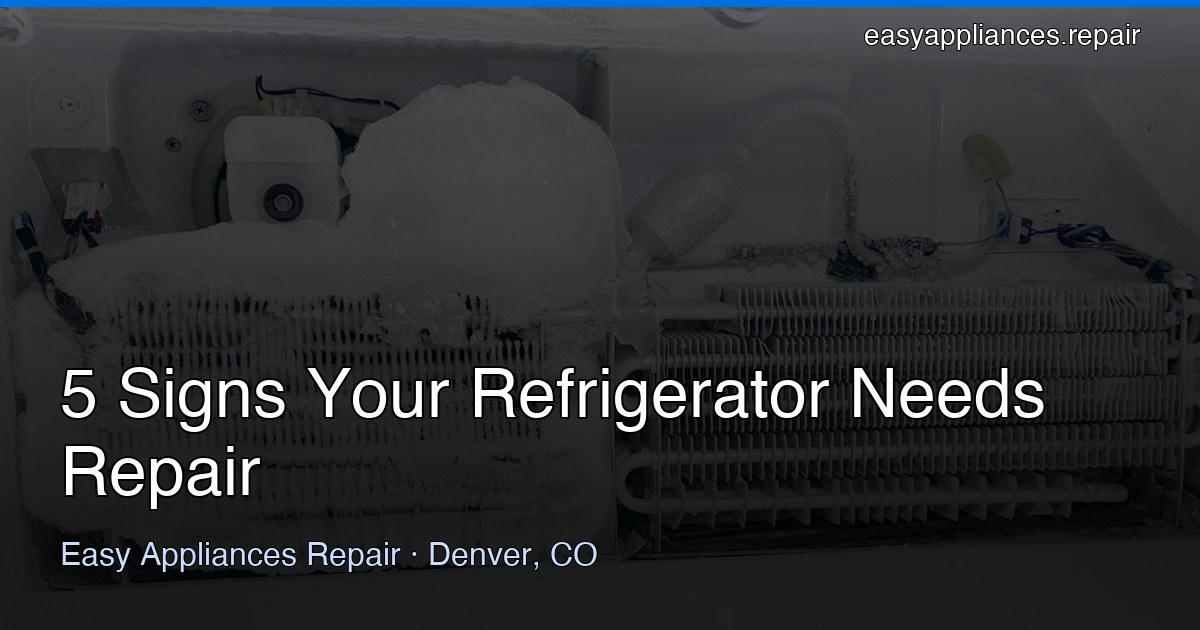
Symptoms: freezer is still cold (frost itself is below freezing), fridge warms up, and when you remove the back panel inside the freezer you see a thick wall of ice over the coil instead of a clean tube. The fastest temporary fix is to unplug the fridge for 24–48 hours to melt the ice. The fridge will work for a few weeks then fail again until the defective defrost component is replaced.
Repair cost: $150–$280 depending on which of the three parts failed. The defrost thermostat is the cheapest at about $150 installed; a control board with adaptive defrost is the priciest at $280. I diagnose all three in one visit and replace what tests bad.
4. Air Circulation Blockage (DIY — $0)
Easy to miss, easy to fix. If you have piled groceries against the rear or side vents inside the fridge — especially after a Costco run — cold air physically cannot circulate. The temperature near the vent reads correctly (the sensor sees cold air) so the system never asks for more, but everything 12 inches away warms up.
Pull everything off the top shelf, locate the vent grille at the back or top of the fresh-food compartment, and make sure nothing is touching it. Leave at least 3 inches of clear space in front of each vent. Also confirm there are 2 inches of clearance behind the fridge for the condenser to breathe.
If the fridge returns to 37–40°F within 8 hours after rearranging food, you found the issue and saved a service call.
5. Thermistor or Sensor Fault ($120–$200)
The thermistor is a small temperature sensor that tells the control board how warm the fridge is. When it drifts out of spec, it tells the board "I am freezing" even when the fridge is warm, so the board never opens the damper or cycles the compressor. Confirm with a multimeter: a healthy thermistor reads about 16 kΩ at 32°F. Anything wildly different (open circuit, near zero, or radically off-temp readings) is a fail.
Thermistor replacement is one of the cheaper fixes on this list, $120–$200 total in Denver. The challenge is access — on some Samsung and LG French-door models, the sensor sits behind interior trim that takes 30 minutes to disassemble.
6. Sealed-System Leak ($400–$900)
If everything above checks out and the freezer is still working only marginally (not freezing solid, but holding food frozen), the refrigerant charge may be low and the system can only cool the lower-pressure evaporator (freezer) before running out of cooling capacity. The fridge gets nothing.
This is the worst-case scenario. Diagnosis requires EPA 608 certification, a manifold gauge set, and access to refrigerant. Repair usually means finding the leak, brazing it, evacuating the system, and recharging with the correct refrigerant. Cost: $400–$900 in Denver, and it only makes financial sense on units under 8 years old or on built-in/counter-depth refrigerators worth several thousand dollars. For more on this, see our refrigerator not cooling troubleshooting guide.
Cost Summary
| Cause | Frequency | Denver Cost |
|---|---|---|
| 1. Damper assembly | ~40% | $150–$300 |
| 2. Evaporator fan motor | ~20% | $180–$320 |
| 3. Defrost system | ~20% | $150–$280 |
| 4. Air circulation blockage | ~10% | $0 (DIY) |
| 5. Thermistor / sensor | ~7% | $120–$200 |
| 6. Sealed-system leak | ~3% | $400–$900 |
All prices include the $75 diagnostic fee — waived when I do the repair — and a 1-year warranty on parts and labor.
Need this fixed? Call (720) 447-8577. Same-day service across Denver, Highlands Ranch, Littleton, Centennial, Lone Tree, Englewood, Aurora, Parker, and Castle Rock. I carry dampers, fan motors, and defrost parts on the truck for the top 5 brands.
Frequently Asked Questions
Why is my fridge warm but freezer cold?
The freezer cools first, then a fan blows cold air up into the fridge through a damper. If the damper is stuck, the fan motor fails, or the defrost system jams, the freezer keeps cooling but no air reaches the fridge.
Can I fix the damper myself?
The damper itself is held in by 2 to 4 screws and a wire harness, so technically yes. But diagnosing whether it is the damper, the thermistor, or the control board sending the wrong signal requires a multimeter. Most DIYers replace the damper unnecessarily.
How long does it take a fridge to cool back down after the damper is fixed?
4 to 8 hours to reach 37°F once the airflow is restored, assuming the fridge is full enough to hold cold but not over-packed.
Is it worth repairing a 10-year-old fridge with this problem?
Yes for damper, fan motor, defrost system, and thermistor repairs — all are under $350. No for sealed-system leaks at $400–$900, where replacement is usually the better call.
Should I unplug the fridge while waiting for service?
No. Keep it running so the freezer holds. Move perishables from the fridge to a cooler with ice. If you hear grinding from the freezer, then unplug it to protect the fan motor from further damage.
Call Victor — Same-Day Refrigerator Repair in Denver
I am Victor, EPA 608 Universal Certified with 7+ years repairing every major refrigerator brand. Easy Appliances Repair has a 4.9 star rating across 128 Google reviews. Every repair carries a 1-year warranty and the $75 diagnostic fee is waived if I do the work. Book online or call (720) 447-8577 — same-day appointments most weekdays. See full refrigerator repair details.