The short version: Samsung french-door refrigerators in the RF23, RF28, and RF30 series share a well-documented ice maker design problem. The number-one failure is a fill-tube freeze caused by an undersized defrost cycle and tight door-seal tolerances, not by a bad water line. A 3-step DIY thaw recovers most units, but a freezer that re-freezes within 2–3 weeks needs the ice maker module replaced. OEM module: $150–$300. Total in-home Denver repair: $250–$400.
The Cost & Pattern at a Glance
| Symptom | Likely Cause | Denver Repair Cost |
|---|---|---|
| No ice produced, fill tube frosted shut | Defrost system undersized, dry climate | $0 DIY thaw or $150 service call |
| Ice cubes hollow, partial, or stuck together | Low water pressure or partial fill-tube ice | $75 diagnostic, often DIY |
| Auger clicks but won’t dispense | Ice clump in bin or stripped auger gear | $250–$400 module replacement |
| Ice maker not making ice at all, no clicking | Failed module or inlet valve | $250–$400 module / $180 valve |
The Pattern Explained: Dry Denver Air + Tight Tolerances + Short Defrost
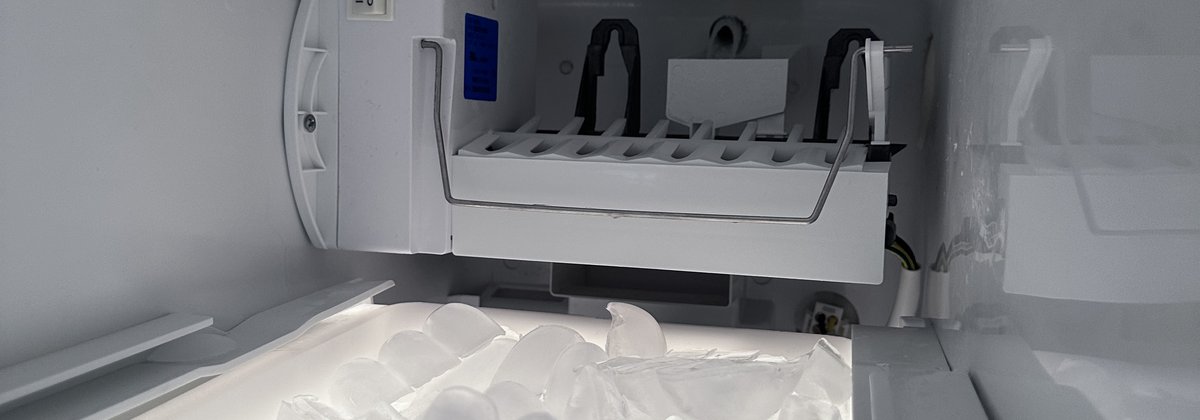
Every Samsung french-door ice maker on the affected models sits in the upper-left fresh-food compartment, not in a dedicated freezer. To keep that compartment at 36°F while producing ice at 24°F, the engineers wrapped the ice maker in an insulated housing with its own small evaporator. That housing has a tiny fill tube about the diameter of a #2 pencil that runs water from a back-of-cabinet inlet valve down into the ice mold.
Here is where the design fails in Denver. The defrost cycle for that mini-evaporator runs only 4–6 minutes every 8–12 hours. When the front door opens, dry 20–30 percent humidity air rushes into the compartment. As that air contacts the chilled ice-maker housing, the tiny amount of moisture it does carry condenses, then freezes onto the fill tube above the mold. Over 60–90 days the fill tube ices shut. No more water reaches the mold, and ice production stops. Owners often describe it as “just stopped working one day.”
It is not your water filter. It is not your inlet valve. It is the fill tube, every time, on these models. Confirming the diagnosis is straightforward and is the first thing I check on every Samsung french-door service call.
The 3-Step DIY Thaw (Most Owners Can Do This in 30 Minutes)
Step 1: Unplug and Empty
Pull the refrigerator out from the wall enough to reach the power cord. Unplug it. Open the left fresh-food door and twist out the ice bucket. Lift it straight up and out, then dump any remaining ice into the sink. Have two old towels ready — one to lay on the floor below the ice maker, one to catch drips at the cabinet base.
Step 2: Hair Dryer the Fill Tube and Mold
Set a standard hair dryer to low heat, low speed. Aim it at the gap above the metal ice mold where you can see the small plastic fill tube. Move the dryer slowly back and forth for 8–10 minutes. You will see water start dripping down within 2 minutes. Do not concentrate heat on one spot — you can warp the plastic auger housing.
Wipe down the housing with the towels. Re-check the fill tube visually; if you can see clean plastic and no ice, you are done. If a frost ring is still visible, give it another 3–5 minutes of warm air. Never use a knife, screwdriver, ice pick, or boiling water. I have replaced cracked ice molds and bent auger blades from every one of those.
Step 3: Plug Back In and Wait 24 Hours
Reinstall the ice bucket. Push the refrigerator back into position. Plug it in. Most Samsung french-door models automatically start a new ice cycle within 90 minutes of power-up, but the mold needs to chill, fill, freeze, and harvest — that is a 6–8 hour cycle. Give it a full 24 hours before you decide whether the thaw worked.
If you get a full ice tray within 24 hours, the thaw was successful. Expect to repeat this in 60–90 days unless you make a habit of pulling the ice bucket and using a hair dryer for a preventive thaw once a month.
When the Module Needs Replacement (Test Procedure)
The full ice maker assembly — mold, heater, thermistor, fill tube, auger motor, gearbox — is sold as one module on Samsung models. Individual parts are not serviceable. When any of the following are true, the module itself is bad and a thaw will not solve it:
- Re-freezes within 14 days after a successful DIY thaw, repeatedly. The thermistor is reading wrong and over-cooling the housing.
- Auger motor clicks but does not spin when you press the dispenser lever, even with no ice in the bin. Stripped auger gear.
- Ice cubes come out malformed — hollow, only half-filled, or fused into one mass — for more than 2 weeks after a thaw. Heater element failing.
- You can hear water filling but no ice appears after 24 hours and the fill tube is verified clear. Thermistor failure preventing harvest.
A simple test I run on every service call: press and hold the “Energy Saver” + “Lighting” buttons together for 8–12 seconds to enter forced test mode. The ice maker should immediately start a harvest cycle — you will hear a single click, then the auger will rotate 180 degrees. If nothing happens within 30 seconds, the module is dead. If the auger rotates but no water enters, the inlet valve is dead. This test takes 60 seconds and is decisive.
Class-Action Context: The 2023 Settlement
Samsung settled a multi-district consumer class action in 2023 covering ice maker defects on select french-door refrigerators manufactured between 2014 and 2020. The settlement set aside approximately $25 million for claims tied to freezing, leaking, slow ice production, and premature module failure. Eligible models included most of the RF23, RF28, and RF30 series, plus certain RF22 and RF26 variants.
The claim filing window closed in late 2023. If you bought your fridge new during the affected window, look through your records — some owners received cash refunds, others received a one-time free repair voucher. You can check Samsung’s official ice maker troubleshooting page for current support options. If the window closed before you were aware of the defect, Samsung has occasionally extended courtesy goodwill repairs for documented complaints — worth one phone call to their executive customer service line.
Models Most Affected
Based on my Denver service calls over the past 8 years, the ice maker failure rate is highest on these model families:
- RF23M series — counter-depth french-door, 2017–2020 manufacture
- RF28R series — standard-depth french-door, 2018–2020 manufacture, particularly RF28R7551SR and RF28R7201SR
- RF28T series — standard-depth french-door, 2020–2022 manufacture, including RF28T5101SR
- RF30HB series — 30 cu ft showcase door, 2015–2019 manufacture
If your model number starts with RF23, RF28, or RF30, the ice maker problems described in this article almost certainly match your symptoms.
What the Repair Costs in Denver
| Service | Cost |
|---|---|
| DIY hair-dryer thaw | $0 — takes 30 minutes |
| In-home professional thaw & diagnostic | $150 (waived if I do the full repair) |
| OEM ice maker module (part only) | $150–$300 |
| Module replacement (parts + shipping + labor) | $250–$400 |
| Water inlet valve replacement | $140–$180 |
I do not stock Samsung ice maker modules on the truck — they are model-specific and ordering after diagnosis is the only way to make sure the part fits. Expect a 2–5 business day turnaround from diagnosis to install. The module itself is the bulk of the cost; labor for the actual swap is roughly 45 minutes.
Prevention — What Actually Helps
I have not found a permanent fix that works on every affected model, but these three practices push the next freeze-up from 60 days to 6 months on most fridges I service:
- Monthly preventive thaw — pull the bucket, hair-dry the fill tube for 3 minutes, reinstall. 5 minutes a month.
- Keep the freezer at 0°F or colder. The factory default is sometimes 5°F. The lower the freezer temp, the better the mini-evaporator can keep up.
- Replace the water filter every 6 months, not the 12 months Samsung recommends. A partially-clogged filter reduces fill pressure, which fills the mold unevenly and increases the chance of stray water freezing on the fill tube.
Ice maker re-froze again after your last thaw? That means the module is failing, not the climate. Call us at (720) 447-8577 or book online — I diagnose Samsung ice maker problems in 20 minutes flat and source the OEM module the same day.
Frequently Asked Questions
Why does my Samsung ice maker keep freezing up?
The fill tube above the ice mold is freezing solid. Water enters through that tube, but on Samsung french-door models (RF23, RF28, RF30) the defrost system runs short, so moisture and stray water droplets refreeze on the tube between cycles. Once it blocks, no new water reaches the mold. This is a design pattern documented across hundreds of thousands of units.
How do I thaw a frozen Samsung ice maker without breaking it?
Unplug the refrigerator, pull out the ice bucket, and direct a hair dryer on low for 8–10 minutes at the fill tube and ice mold. Catch dripping water with a towel. Plug back in and wait 24 hours for the first new ice cycle. Do not use a knife, screwdriver, or boiling water — those damage the auger blades and crack the mold.
Which Samsung refrigerator models are affected by the ice maker class action?
The 2023 settlement covered select french-door models manufactured between 2014 and 2020, including the RF23 series, RF28 series (RF28R, RF28T), RF30HB, and certain RF22 and RF26 variants. Samsung set aside roughly $25 million for claims tied to ice maker freezing, leaking, and slow production. The claim filing window closed in late 2023.
How much does it cost to replace a Samsung ice maker module in Denver?
The OEM module itself runs $150–$300 depending on the model. With shipping, diagnostic, and labor, the total Denver in-home repair is typically $250–$400. Aftermarket modules cost less but I do not recommend them — the auger gear strips out within 12 months on most aftermarket units I have replaced.
Is the dry Denver climate making my Samsung ice maker problem worse?
Indirectly, yes. Denver’s low ambient humidity is not the cause, but the tight door-seal tolerances on Samsung french-door models combined with frequent door openings (warm dry air entering, cold humid air leaving the compartment) cause more frost buildup on the ice maker housing than in humid climates. The defrost system was not engineered for that pattern.
Call Victor — Samsung Ice Maker Repair in Denver
I’m Victor, EPA 608 Universal Certified, experienced with Samsung refrigerators, with 7+ years repairing french-door models throughout the Denver metro. I service Samsung refrigerators from Highlands Ranch and Littleton to Aurora and Centennial. For more on this class of repair, see my guides on ice maker repair, why ice makers stop making ice, and the ice maker module glossary entry. Call (720) 447-8577 or book online — same-day diagnostic in most of the Denver metro.