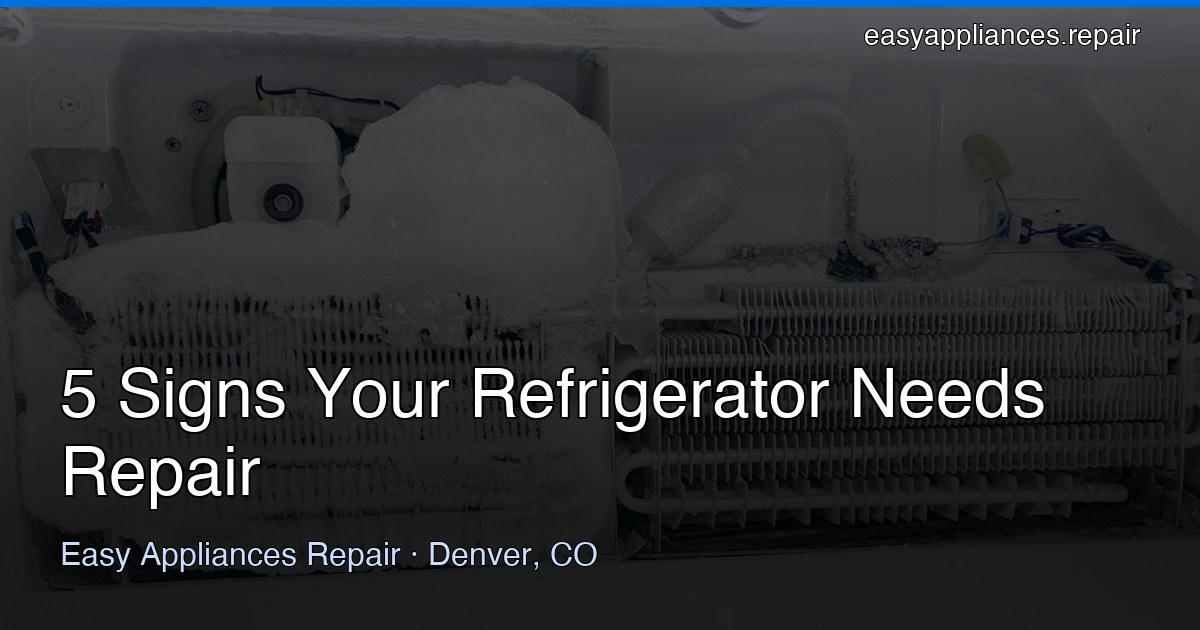
Short answer: An ice maker that stops producing has six failure points, in order of frequency: the water supply line (DIY check), the water inlet valve ($150–$250), a frozen fill tube (DIY thaw, common in Denver dry winters), the ice maker module ($150–$300), the thermostat ($120–$200), and on some brands the optic emitter boards ($150–$250). This guide is the cost-focused listicle version—if you want a decision-tree diagnostic instead, see our step-by-step troubleshooting walk-through.
I’m Victor, EPA 608 Universal Certified, 7+ years repairing refrigerators in Denver. Ice maker calls spike every January when Front Range humidity drops to 15–20%. The fill tube freeze pattern alone accounts for maybe a quarter of my January calls. Knowing the symptom is half the diagnosis. Here is what to check and what each fix costs.
2026 Denver Cost Snapshot
| Check | Cost | DIY? | Time |
|---|---|---|---|
| 1. Water supply line | $0–$25 | Yes | 10 min |
| 2. Water inlet valve | $150–$250 | Partial | 45 min |
| 3. Fill tube freeze | $0 | Yes | 15 min |
| 4. Ice maker module | $150–$300 | No | 1 hr |
| 5. Thermostat | $120–$200 | No | 45 min |
| 6. Optic emitter board | $150–$250 | No | 45 min |
1. Water Supply Line (Check First — Free)
The water supply line connects your home plumbing to the back of the refrigerator. The shutoff (a saddle valve on older homes, a quarter-turn ball valve on newer ones) sits behind the fridge or under the sink. If anyone pulled the fridge out recently—painting, floor work, cleaning—the valve may have been closed or the line kinked.
How to check: pull the fridge out 6 inches and look at the line. Trace it to the shutoff. The handle should be parallel to the pipe (open). Run a glass at the water dispenser—if no water comes out (or pressure is weak), the supply is restricted. Fix by opening the valve fully or straightening the kink. Time: 10 minutes. Cost: free unless you need a replacement saddle valve ($15–$25 at any hardware store).
2. Water Inlet Valve ($150–$250)
The water inlet valve is the electromechanical solenoid that admits water from the supply line to the ice maker. The control board sends a signal during the ice-making cycle, the solenoid coil energizes, the valve opens, water flows for about 7 seconds, then the valve closes. When the solenoid burns out, you get no water at the ice maker even though the dispenser still works (those use a separate path on some models).
How to diagnose: listen during the harvest cycle (usually triggerable by pressing the test button on the side of the ice maker module). You should hear a click followed by water flow. No click = solenoid bad. Click but no flow = valve mechanically stuck or supply clogged.
Replacement cost: $150–$250 in Denver including the OEM part. Denver’s moderately hard water scales up the inlet screens over 4–6 years, which is the primary cause of valve failure here. See our water inlet valve glossary entry for visual reference.
3. Fill Tube Freeze (DIY Thaw — Common in Denver Dry Winters)
This is a Denver-specific pattern. When ambient humidity drops below 25% (every winter, January and February especially), the fill tube—the small white plastic tube that delivers water from the inlet valve to the ice maker mold—can freeze closed. Water from the previous cycle freezes against the tube wall instead of evaporating, ice grows backward into the tube, and the next cycle has nowhere to send water. The maker fills the ice mold with the small amount of trapped water, then stops.
How to confirm: turn off the ice maker (most have an on/off lever or a paddle behind the bin). Pull the bin out and look at the back of the freezer at the top of the ice maker mold. A frozen fill tube has a visible ice plug at the opening.
Fix: use a hair dryer on low heat or a hot wet towel for 5–10 minutes. Keep the dryer 6+ inches from any plastic. Once the ice melts out, turn the ice maker back on and let it run a full cycle. To prevent recurrence in dry weather, run the ice maker more frequently (every day—don’t leave it off for weeks) so warm fresh water flushes the line.
4. Ice Maker Module ($150–$300)
The ice maker module is the entire harvest mechanism: motor, gears, mold, ejector arm. When the motor seizes or the timing gears strip, the maker fills with water, freezes, and never harvests—or harvests crooked, breaking cubes against the side. On Samsung and LG French-door fridges, the module is replaced as a single unit. On Whirlpool and KitchenAid the harvest motor can be swapped separately for less.
Replacement cost: $150–$300 in Denver. The OEM module is $80–$180; labor is $80–$140 for an in-and-out swap. Less common on Samsung RF28 because of the recall pattern below.
See our ice maker module glossary entry for diagnostic procedures.
5. Thermostat ($120–$200)
The ice maker thermostat (sometimes called the bimetal switch) tells the module when the water in the mold has frozen solid and it’s safe to harvest. If the thermostat fails open, the module thinks the water is never cold enough and never tries to eject. Symptoms: full water in the mold, no harvest, ever.
Cost: $120–$200. The part is small and cheap ($15–$30); most of the cost is labor to disassemble the module. Worth doing only if the module otherwise looks healthy.
6. Optic Emitter Board ($150–$250) — Whirlpool, KitchenAid, Maytag
Whirlpool family fridges (Whirlpool, KitchenAid, Maytag, Jenn-Air) use an infrared sensor pair—an emitter on one side of the bin, a receiver on the other—to detect ice level. When the bin fills, the IR beam blocks and the maker stops. When you scoop ice out, the beam clears and the maker resumes.
When the emitter or receiver fails (or the lens fogs over), the board sees a permanently full bin even when empty, and stops production. Diagnostic LED on the emitter board: blinks twice per second normally; off or 9 blinks indicates failure.
Replacement cost: $150–$250. The boards are sold as a matched pair on most KitchenAid and Maytag models.
Samsung RF28 Recall Pattern
Samsung RF28 series French-door refrigerators (RF28HMEDBSR, RF28K9070SR, RF28R6201SR and related models) have a long-running ice maker problem that triggered a class-action settlement and multiple service bulletins. The failure mode: ice builds up around the maker assembly, the unit freezes solid, the auger jams, and the fan fails. Eventually no ice production at all.
If you own an RF28-series Samsung built 2014–2020, before paying for any repair:
- Check your serial number against the Samsung settlement portal (search “Samsung ice maker class action settlement”).
- Call Samsung Customer Service with the serial. Many RF28s qualify for free service bulletin work.
- If denied or out of coverage, the in-warranty repair is typically a full assembly replacement at $400–$600 in Denver (including modified airflow shroud that addresses the known design issue).
I see Samsung RF28 ice maker calls weekly. About 30% qualify for free repair under the settlement, so always check first. For other Samsung issues see Samsung refrigerator repair.
Diagnostic Order (15-Minute Walk-Through)
- Run the dispenser: If water comes out cleanly, supply and inlet valve are fine on the dispenser side. Skip to step 3.
- If no water: Pull fridge out, check shutoff and line for kinks. If OK, suspect inlet valve.
- Pull the ice bin: Look at the fill tube and the mold. Frozen fill tube? Thaw. Otherwise, check the bin level mechanism (paddle or IR sensor).
- Press the test button on the side of the ice maker module: The harvest cycle should run for about 3 minutes—ejector arm rotates, water flows in. If nothing happens, module is dead. If water flows but ejector doesn’t move, harvest motor or thermostat.
- Wait 24 hours after any fix. A normal ice maker needs 4–5 cycles (about 4 hours) to produce visible ice, and 24–48 hours to fill the bin.
When Repair Doesn’t Make Sense
An ice maker repair on a refrigerator past 10 years old is a judgment call. The maker itself can run $200–$300 to fix, but if the compressor or main board is also approaching end of life, the math swings toward replacement of the whole fridge. As a rule:
- Fridge under 5 years: Always repair. The ice maker is the cheapest component and the rest of the unit has plenty of life.
- Fridge 5–8 years: Repair if cost is under 30% of replacement (about $450 for a $1,500 fridge).
- Fridge over 10 years: Replace unless the fix is a $0 fill-tube thaw or a $200 module on a high-end built-in.
FAQ
Why does my ice maker stop working in winter?
Denver winter dry air (often 15–20% relative humidity) can freeze the ice maker fill tube closed. Thawing the tube with a hair dryer often restores normal operation.
How long should it take for a new ice maker to start producing?
Most ice makers need 12–24 hours after install to start a normal cycle, and 48–72 hours to fill the bin completely.
Is the Samsung RF28 ice maker really under recall?
Samsung has issued multiple service bulletins, and a class-action settlement covers the RF28 ice maker assembly. Check your serial number against Samsung’s settlement portal before paying for repair.
How much does ice maker repair cost in Denver?
Water inlet valve $150–$250, ice maker module $150–$300, thermostat $120–$200, optic boards $150–$250. Water-supply fixes are usually DIY.
Should I replace just the ice maker or the whole refrigerator?
If the fridge is under 8 years old, replace just the ice maker. Past 10 years, weigh the next likely failures (compressor, control board) before sinking more money into a single component.
Worked through the checklist and still no ice? Call (720) 447-8577 or book online. I carry water inlet valves, ice maker modules, and thermostats for Samsung, LG, Whirlpool, KitchenAid, and GE on the truck. $75 diagnostic, waived with repair. 1-year warranty.
About Easy Appliances Repair
I’m Victor, owner-operator. EPA 608 Universal certified, 7+ years on residential ice makers throughout Denver. Every repair includes a 1-year parts-and-labor warranty. I service ice maker repair across the Denver metro—Highlands Ranch, Littleton, Centennial, Aurora, Parker, Castle Rock, and Lone Tree.