Short answer: An oven that browns one side faster than the other, or bakes a cake gummy in the middle and burned at the edges, almost always has one of five problems: a drifted calibration (free to fix), a worn bake element ($150–$280), a failing convection fan motor ($180–$320), a drifting temperature sensor ($120–$200), or a leaky door gasket ($180–$280). Try calibration first—it costs nothing and accounts for roughly a third of the “uneven oven” calls I run in Denver.
Hot spots feel like a cooking problem, but the diagnosis is usually mechanical. Once you know which of the five components is drifting, the fix becomes obvious. Here is the diagnostic in the same order I run it on a service call.
Cost Snapshot: 5 Common Causes (Denver, May 2026)
| Cause | Total cost | DIY? | Try first |
|---|---|---|---|
| Calibration drift | Free | Yes | Always |
| Bake element worn | $150–$280 | Partial | After calibration |
| Convection fan motor | $180–$320 | No | If one-sided |
| Temperature sensor | $120–$200 | No | If overall hot/cold |
| Door gasket leak | $180–$280 | Partial | If front edge cool |
Bread Test: The 6-Minute Diagnostic
Before you do anything else, run a bread test. Lay six slices of plain white bread on a half-sheet pan in two rows of three (left, center, right; front and back). Bake at 350°F for 6 minutes. The browning pattern is the most useful piece of diagnostic data you can give a technician (or use yourself) because it shows exactly where the heat is going.
- Back too dark, front too pale: door gasket leak (cause 5) or fan motor (cause 3).
- One side darker than the other: convection fan motor failing on the bright side (cause 3) or bake element burning unevenly on the dark side (cause 2).
- All slices equally pale or equally dark: calibration drift (cause 1) or temperature sensor (cause 4).
- Slices burned on bottom, raw on top: the broil element is not engaging during the preheat phase—control board issue.
1. Calibration Drift (Try This First — Free)
Every modern oven lets you adjust its internal thermostat by ±35°F (sometimes ±50°F) through the control panel. Over 5–8 years the temperature reference drifts as the sensor ages and the bake element loses watts. The oven still “works” but reads 25°F lower than reality—or higher.
How to recalibrate: bake a sheet of bread, decide if the oven needs to come down 15°F or up 15°F (based on visible browning vs. expected at 350°F for 6 minutes), then enter the offset. The menu path varies by brand:
- Samsung NE63 series: Settings → Oven → Bake Temperature Adjust. Range -35 to +35F.
- LG LRG series: Hold “Bake” for 6 seconds, then use arrow keys to adjust. Range -35 to +35F.
- Whirlpool WFE / WEE series: Settings → Calibration. Range -30 to +30F.
- GE Profile PB / PHB series: Bake + 9 + 0, then enter offset. Range -35 to +35F.
About a third of the “my oven bakes unevenly” calls I run end here. The owner adjusts 15–20°F, retests, and everything bakes correctly. Cost: $0.
2. Bake Element Worn ($150–$280)
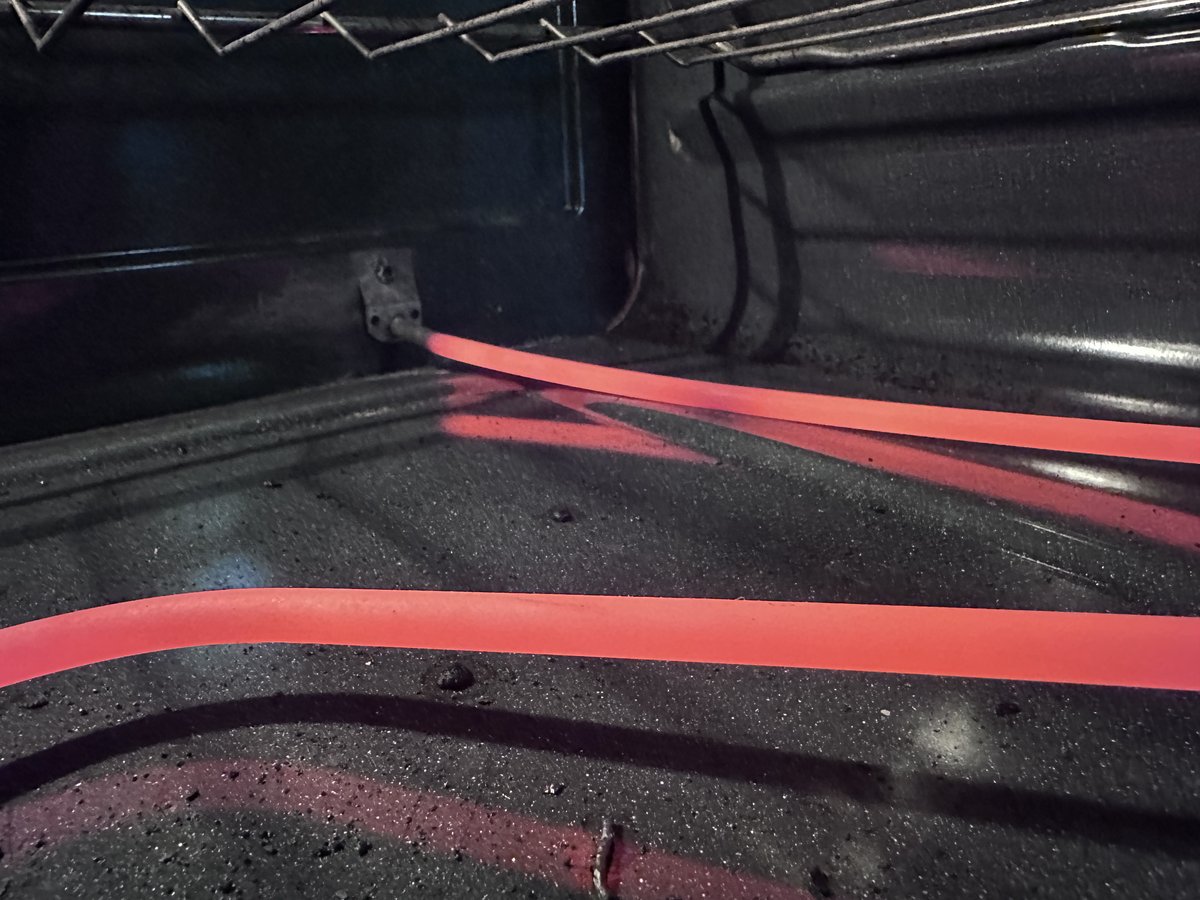
The bake element is the U-shaped resistance heater at the bottom of an electric oven. It does most of the actual heating in standard Bake mode. After 8–12 years it develops bright spots, blisters, or hot “loops” that draw more current than the rest of the element. The visible result: one half of the oven floor radiates more heat than the other.
How to inspect: with the oven cold, pull out the racks and look at the element. A healthy element is a uniform dark gray, almost charcoal. A failing element has a bright silvery patch, a visible blister, or a fine hairline crack. If you see any of those, the element is on borrowed time.
Element replacement is one of the simpler oven repairs—two screws hold it to the back wall and the wires push on. But on most Samsung NE63 and GE Profile PB ovens, the screws are recessed into the convection ducting and require partial disassembly to reach. The Denver going rate including the OEM part is $150–$280. See our heating element glossary entry for visual references.
3. Convection Fan Motor Failing ($180–$320)
If your oven has a convection fan—the small motor behind a perforated rear panel—it pushes hot air in a circulating pattern. When the motor bearing dries out, the fan slows, stops, or wobbles, and one side of the cavity gets noticeably more heat than the other.
Diagnostic: with the oven warm but off, open the door and reach back to the rear panel. You should hear the fan slow to a stop within a few seconds and feel no rattle. If you hear scraping or the fan keeps spinning unevenly long after the oven shuts off (or refuses to spin at all when on), the motor needs replacement.
Convection motor cost in Denver: $180–$320. The motor itself is $80–$160; labor is two hours because the rear panel insulation must come out. Most affected brands in my book: Samsung NE63 (convection bearing wear at 6–8 years), Whirlpool WFE (5–7 years), and LG LRG (8–10 years).
4. Temperature Sensor (Thermistor) Drifting ($120–$200)
The oven temperature sensor is a thin metal probe sticking out of the upper-left or upper-right corner of the cavity. It feeds the control board a resistance signal that the board converts to a temperature reading. When the probe degrades, the signal lies—the board thinks the oven is at 350°F when it’s actually 380°F, so it cuts power early. Result: the bake stalls before the cake sets.
The symptom is global, not directional—everything bakes pale, or everything burns. Combined with a bread test that’s “all dark” or “all pale,” a drifting sensor is the likely cause.
Replacement: $120–$200 including the OEM part. The sensor unscrews from the rear wall with two screws and the wire harness pushes on through a hole in the back of the cavity. Fast repair—30 minutes once parts are on site.
5. Door Gasket Leak ($180–$280)
The fiberglass rope gasket around the oven door creates the cavity seal. When the gasket compresses, tears, or pulls loose at a corner, hot air escapes and the front of the cavity runs noticeably cooler. The bread test signature: back row dark, front row pale.
Inspect by opening the door and running a finger around the gasket. It should feel uniformly springy. Crushed spots, tears, or missing sections all indicate replacement. On most modern ovens the gasket clips into stainless tabs around the cavity opening—no tools required—but the replacement gasket is OEM-only and runs $80–$140. Add $100–$140 labor for the service call.
Quick note: a tired gasket also wastes energy. Replacing it on an 8-year-old oven typically saves $40–$60 a year in cooking-related electricity. More detail on the part itself in our door gasket glossary entry.
Brand-Specific Patterns
After 7 years of repairs in the Denver metro, certain brands show predictable hot-spot causes:
- Samsung NE63 series (NE63A6111SS, NE63T8511SS): convection bearing wear at year 6–8 is the dominant cause. Sensor drift is secondary.
- LG LRG series (LRG3061ST, LRGL5825F): bake element “hot loop” failure at year 8–10. Element replacement is straightforward.
- Whirlpool WFE/WEE series (WFE505W0HZ, WEE745H0FS): door gasket compression is the most common cause. Replace gasket and recalibrate.
- GE Profile PB / PHB series (PB960SJSS, PHB920SJSS): temperature sensor drift first, then control board. PB960 specifically has a known sensor pattern at year 7–9.
When to Call vs. Try Yourself
The free diagnostics—bread test, calibration adjustment, visual element inspection, gasket squeeze—cost nothing and resolve about 40% of these calls. The other 60% need a technician because the failed component (sensor, fan motor, element wiring) requires either electrical work or disassembly that’s not safe for a homeowner.
If you’ve recalibrated and the unevenness persists, book a diagnostic. Bring your bread-test photo to the appointment—it cuts diagnostic time in half. Most uneven-heating repairs are completed the same visit because I carry common bake elements, sensors, and convection motors on the truck.
FAQ
Is it normal for an oven to have a hot side?
A 10–15°F variance between corners is typical. Anything beyond 25°F is a calibration or hardware problem and produces visible uneven baking.
Can I bake without convection if the convection fan is broken?
Yes for short term. Standard bake mode doesn’t require the fan. But on many models the fan motor shares wiring with the bake element circuit, so a failed motor can trip other functions.
Does Denver altitude affect oven temperatures?
Altitude affects food chemistry (water boils at 202°F instead of 212°F) but it doesn’t change the oven cavity temperature. A 350°F oven measures 350°F at the rack at any elevation.
How much does it cost to fix uneven oven heating in Denver?
Bake element replacement runs $150–$280, convection fan motor $180–$320, temperature sensor $120–$200, and door gasket $180–$280. Calibration is free.
Should I replace an oven that bakes unevenly?
If the oven is under 10 years old and the repair is under $350, fix it. Past 12 years with a control board involved, consider replacement.
Tried calibration but still getting hot spots? Call (720) 447-8577 or book online. I carry bake elements, sensors, and convection motors for Samsung, LG, Whirlpool, and GE Profile on the truck. $75 diagnostic, waived with repair. 1-year warranty.
About Easy Appliances Repair
I’m Victor, owner-operator. EPA 608 Universal certified, 7+ years on residential and built-in ovens across Denver, 128 Google reviews. Every repair includes a 1-year parts-and-labor warranty. I service oven and stove repair throughout the south metro—Highlands Ranch, Littleton, Aurora, Centennial, Parker, Castle Rock, Lone Tree, and Greenwood Village.