URGENT SAFETY — READ FIRST. If you smell gas right now — even faintly — stop reading and do this:
- Do not flip any light switch, do not start an exhaust fan, do not light a match or lighter. Each one can be an ignition source.
- Get everyone out of the house. Leave the door open behind you.
- Call Xcel Energy from outside at 1-800-895-2999 (24/7 gas emergency line) or 911. Do not call from inside the house.
- Do not return inside until Xcel confirms the home is clear.
Component troubleshooting comes after the leak check is done. Continue reading only if there is no leak.
Short answer: A gas range that clicks (or glows) but won’t light, combined with a gas smell, has one of two stories. Either there’s an actual leak somewhere in the supply or a stuck-open valve—in which case Xcel Energy handles it—or the burner is releasing a tiny amount of unburned gas before ignition (which can be normal for 2–3 seconds, but persistent smell is not). This guide walks through both paths.
I’m Victor, EPA 608 Universal Certified with 7+ years on Denver gas appliances. I get this call probably twice a month, especially during the cold-weather windows when everyone fires up their range for holiday cooking. The cause is almost never the gas line itself—it’s usually a worn ignition component letting unburned gas escape. But you cannot diagnose that in a house with a gas smell. The leak check has to come first.
When to Call Xcel Energy vs. When to Call a Repair Tech
| Situation | First call | Cost |
|---|---|---|
| Strong gas smell anywhere in the home | Xcel 1-800-895-2999 | Free |
| Faint smell only at the stove during ignition attempts | Xcel for safety check, then tech | Free + $75 |
| CO alarm or gas detector going off | 911 then Xcel | Free |
| Range clicks but no light, no smell at all | Repair tech | $75 diagnostic |
| Oven won’t light, cooktop works, no smell | Repair tech | $75 diagnostic |
Xcel Energy responds 24/7 to suspected gas leaks at no charge. They will inspect the meter, the line into your home, and run a combustible-gas check throughout the kitchen. If they find no leak in the supply, they’ll either shut off gas to the range and tell you to call an appliance technician, or hand off the kitchen back to you clear. That hand-off is when I (or another licensed tech) come in.
What Causes the Smell If There’s No Leak
When the supply is clean and you still smell gas at the range, the issue is unburned fuel escaping into the cabinet during ignition attempts. Three things can do that:
- A weak hot surface igniter: Gas opens through the safety valve and flows for 30–60 seconds while the igniter struggles to reach ignition temperature. Most of that gas escapes unburned.
- A failing spark module: The module sparks but timing is off; gas valve opens but the spark misses the gas cloud.
- A dirty spark electrode: Carbon or grease on the tip prevents a clean spark. Gas flows, no ignition, smell.
None of these are leaks in the plumbing sense—they’re ignition failures that release small amounts of fuel each time you turn the dial. Once Xcel verifies no supply leak, this is the next thing to look at.
Component Diagnostics (After Xcel Has Cleared the Home)
1. Hot Surface Igniter ($180–$280)
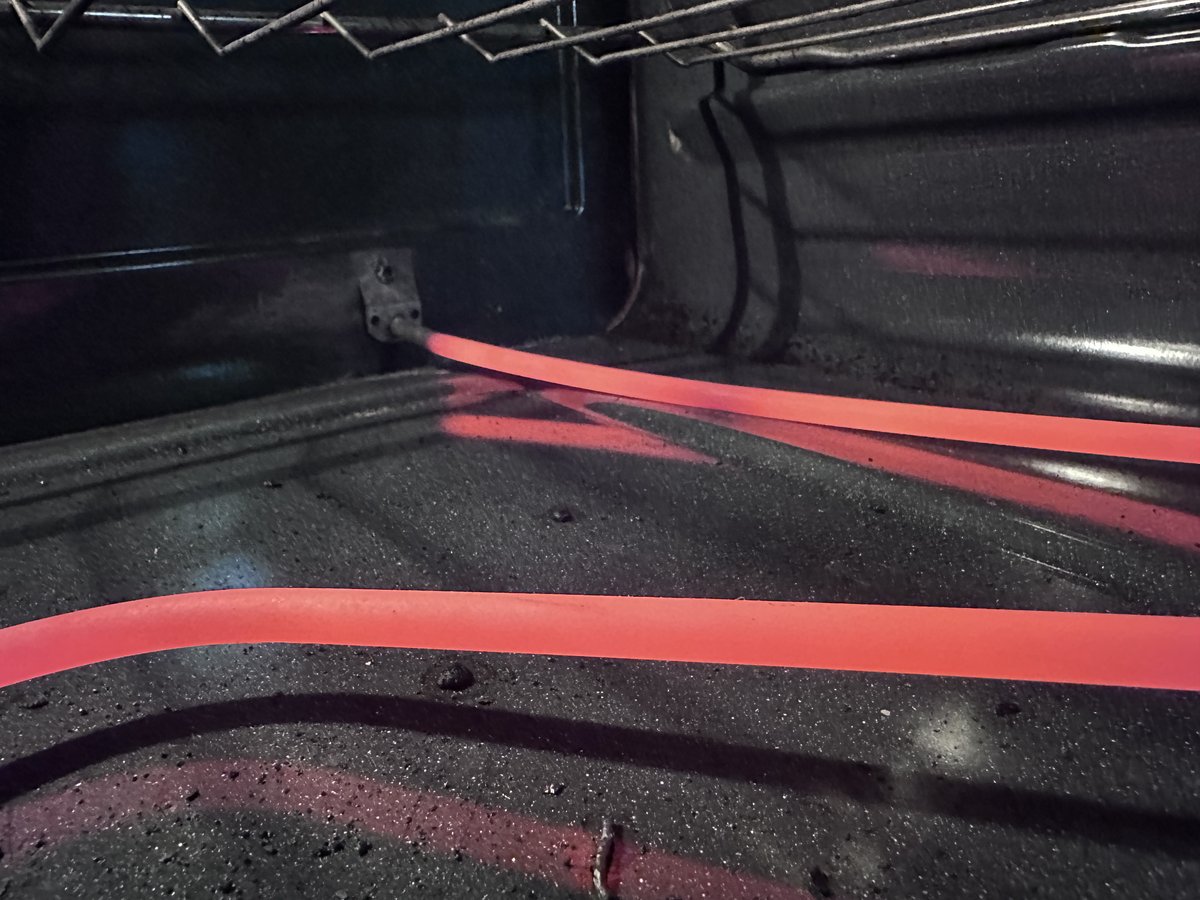
The hot surface igniter is a ceramic-and-silicon-carbide element that heats to about 1,800°F to ignite gas in the oven. It also opens the safety valve electrically: gas only flows when the igniter draws enough current to satisfy a sensor in the safety valve circuit. As the igniter ages, it still glows, but it pulls less current. Gas opens, igniter glows orange (not the bright orange-white required), and gas escapes for 30–60 seconds before the safety valve closes again. That’s where the smell comes from.
This is the most common cause of “won’t light, smells like gas” on Whirlpool, GE, Frigidaire, and KitchenAid ovens. Replacement at $180–$280 in Denver. See our hot surface igniter glossary entry for diagnostic photos.
2. Spark Module ($200–$320)
The spark module is the small electronic box (usually mounted on the back or side of the range chassis) that fires the spark electrodes at each cooktop burner. When you turn a knob, it sends a 10–20 kV pulse to the electrode. If the module fails or the timing drifts, you get the “click click click” sound but no flame. Worse, on some failure modes the gas valve still opens during the clicking, so unburned gas flows.
Spark module replacement in Denver: $200–$320. Common on Samsung, LG, and Bosch gas cooktops; less common on Whirlpool. See spark module glossary for details.
3. Spark Electrode ($120–$200)
The spark electrode is the porcelain-tipped probe sticking up between the burner head and base. It carries the spark to the gas. Over time, the porcelain cracks (often from spillover) or the tip gets coated with carbonized grease. Spark either jumps to ground (cooktop chassis) instead of the gas, or fails to spark at all. Gas flows, you smell it, no light.
Replacement: $120–$200. This is the only component on the list where careful cleaning sometimes helps—a Q-tip with isopropyl alcohol on a cold electrode tip can buy you another year. But if the porcelain has visible cracks, it has to be replaced.
4. Safety Valve ($250–$400)
The safety valve is the gas regulator in the oven (and sometimes in cooktop burners) that opens only when the igniter draws enough current. When it fails partially open, gas leaks even when the burner is off. Less commonly, when it fails closed, you get no gas at all and no smell. The first case is the dangerous one and the one Xcel will catch immediately if it’s severe.
Safety valve replacement: $250–$400. This is never DIY. Replacing a safety valve requires shutting off gas, dropping the valve assembly, leak-testing the new valve with combustible-gas detector, and pressurizing. I always pressure-test and detector-check before reconnecting power. See our safety valve glossary entry.
5. Control Board ($300–$550)
On smart ovens with touchscreens (Samsung NE63, LG LRG, GE Profile PB), the control board sequences the igniter and safety valve. If the board fails to send the igniter signal but mistakenly opens the valve, gas escapes. This is rare but does happen, especially after a power surge.
Control board replacement: $300–$550 depending on the brand. On premium brands (Wolf, Thermador, Viking) the part is OEM-only and can be $700+.
Why You Should Never DIY a Gas Range Repair
I am genuinely happy to lose a service call when a homeowner can DIY safely. Electric dryer belt? Go for it. Dishwasher drain hose? Sure. But gas ranges are different. Three reasons:
- The safety valve is non-bypassable. If you remove it, replace it, and don’t leak-test, you can build a slow leak in the cabinet that doesn’t smell until concentrations reach explosive levels.
- Ignition components are wired to gas valves. You can’t test the igniter circuit without gas in the line, and you can’t safely test gas pressure without a manometer and combustible-gas detector.
- Insurance. If a gas-related fire is traced to homeowner repair, most policies will not pay.
A licensed appliance technician has the manometer, the combustible-gas detector, and (in my case) EPA 608 Universal certification. I can do the repair in 60–90 minutes with a documented leak check at the end. The $75 diagnostic is waived when you book the repair.
Cost Snapshot
| Component | Cost (Denver) | Frequency |
|---|---|---|
| Xcel leak check | Free | If smell present |
| Hot surface igniter | $180–$280 | Most common |
| Spark module | $200–$320 | Cooktop |
| Spark electrode | $120–$200 | Per burner |
| Safety valve | $250–$400 | Less common |
| Control board | $300–$550 | After surges |
Related Reading: Oven-Specific Diagnostics
If your specific issue is the oven not lighting (cooktop works fine), see the dedicated walk-through at gas oven not igniting. That guide focuses on the safety-valve-and-igniter circuit and includes a step-by-step diagnostic. For cooktop burners specifically, see cooktop repair.
Outbound Safety Resources
- Xcel Energy Gas Emergency: co.my.xcelenergy.com/s/safety/natural-gas-safety — 24/7 emergency line 1-800-895-2999
- CPSC Gas Range Safety: Carbon Monoxide Information Center
FAQ
Is it dangerous to smell gas at the stove?
Yes. A faint, intermittent smell during ignition is normal for 2–3 seconds. A persistent or strong smell is dangerous and requires immediate evacuation and a call to Xcel Energy at 1-800-895-2999.
What is the difference between Xcel Energy and a repair tech for a gas range?
Xcel handles the gas supply (the line and meter). They’ll shut off gas, leak-check, and confirm safety. A repair tech handles components inside the appliance (igniter, valve, board) once Xcel confirms no supply-side leak.
Why does my gas range click but not light?
The spark module is firing but gas isn’t reaching the burner, or the spark is missing it. Causes: closed appliance shutoff valve, clogged burner ports, dirty electrode, or stuck safety valve. If you smell gas during the clicking, stop and ventilate.
How much does gas range repair cost in Denver?
Hot surface igniter $180–$280, spark module $200–$320, spark electrode $120–$200, safety valve $250–$400, control board $300–$550. $75 diagnostic, waived with repair.
Should I use my gas range if it smells faintly of gas?
No. Even a faint persistent smell warrants a leak check from Xcel before further use. Gas at low concentrations isn’t always detectable to smell. Use a portable CO monitor and combustible-gas detector if available.
Home cleared by Xcel and range still won’t light? Call (720) 447-8577 or book online. I carry hot surface igniters, spark modules, and electrodes for Samsung, LG, GE, Whirlpool, KitchenAid, Bosch, and Wolf on the truck. $75 diagnostic, waived with repair. 1-year warranty.
About Easy Appliances Repair
I’m Victor, owner-operator. EPA 608 Universal certified, 7+ years on gas appliances throughout Denver. Every gas repair includes a documented leak check with combustible-gas detector and a 1-year parts-and-labor warranty. I service oven and stove repair across Denver, Highlands Ranch, Littleton, Aurora, Centennial, Parker, Castle Rock, Lone Tree, and Greenwood Village.