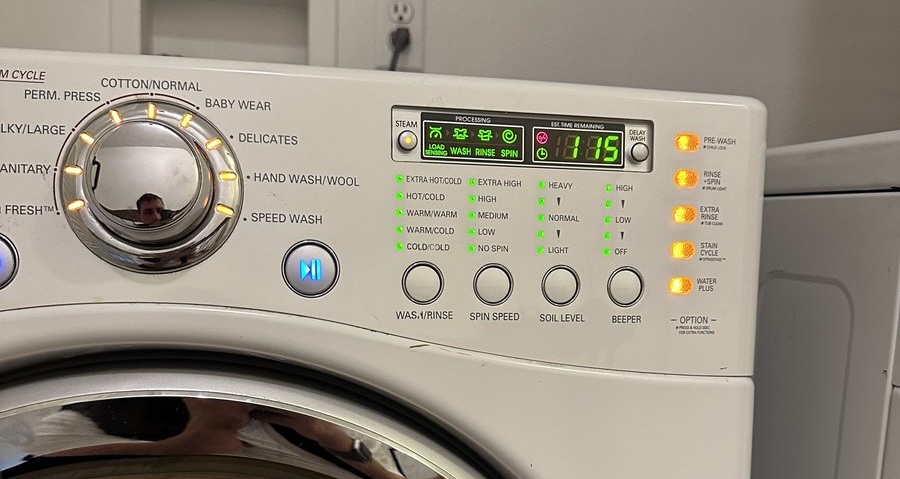
LG washers display error codes when a sensor reading falls outside the control board’s expected range. The code tells you where the fault is, not what failed — that’s the job of diagnosis. 7+ years repairing LG front-load and top-load washers across Denver, I’ve seen the same 15 codes account for roughly 95% of service calls. This guide covers every one: what it means, what you can check yourself in 10 minutes, and the cost to fix it if a technician is needed.
If you’re here for one specific code, use the table below to jump straight to it. For the OE drain error specifically, I’ve written a separate deep-dive: LG washer OE error code — complete guide.
LG Washer Error Code Comparison Table
| Code | Meaning | Likely Cause | Fix Cost (Denver) |
|---|---|---|---|
| OE | Drain failure | Clogged pump filter or drain hose | $0–$220 |
| UE / uE | Unbalanced load | Redistribute laundry or worn shocks | $0–$280 |
| LE | Motor locked | Hall sensor or stator winding | $180–$520 |
| CL | Child lock | Lock engaged — not an error | $0 |
| dE / dE1 / dE2 | Door open / latch | Failed door switch or latch | $140–$220 |
| IE | Inlet / water supply | Closed valve, clogged screens, bad inlet valve | $0–$190 |
| FE | Overfill | Stuck inlet valve or pressure sensor | $160–$240 |
| tE | Temperature sensor | NTC thermistor or heater circuit | $170–$260 |
| PE | Pressure sensor | Pressure switch or tube clogged | $150–$230 |
| SE | Motor / Hall sensor | Hall sensor wire or rotor magnet | $220–$420 |
| Sud / SUDS | Excess suds | Non-HE detergent or overdose | $0–$120 |
| AE | Leak detected | Tub seal, door boot, or hose leak | $150–$520 |
| E1 | Leak sensor (older) | Same as AE on older boards | $150–$520 |
| FF | Freezing fault | Frozen drain line (garage / unheated) | $0–$140 |
| dHE / HE | Dryer heater (combo units) | Heating element or thermistor | $180–$340 |
Prices include parts and labor for the Denver metro area as of May 2026. My $75 diagnostic fee is waived when you book the repair with me. Now let’s go through each code in detail.
OE — Drain Failure
The OE code means the washer didn’t drain to empty within the expected time window. The control board polls the pressure sensor during the drain phase; if water level doesn’t drop, OE triggers. In 80% of OE calls I run in Denver, the cause is a coin, hairpin, or bra wire jammed in the drain pump impeller — not a failed pump.
DIY check: Unplug the washer. Open the small access panel at the bottom front of the cabinet. Place a shallow pan underneath, unscrew the drain filter cap counter-clockwise, and let water drain out. Pull the filter, clear any debris, and inspect the impeller behind it for obstructions. Reinstall and run a rinse cycle to test.
When to call: If the filter is clean and the drain hose isn’t kinked, the drain pump motor itself has failed. Replacement runs $180–$220 in Denver. Full breakdown: LG washer OE error — complete guide.
UE / uE — Unbalanced Load
UE (capital) means the washer detected an unbalanced load and is trying to redistribute it; lowercase uE on newer models means the same thing but on a different firmware revision. The drum’s suspension sensors flag uneven weight to prevent the tub from slamming the cabinet during spin. Most UE codes resolve themselves once you rearrange a tangled bedsheet or comforter.
DIY check: Pause the cycle, redistribute the load so heavy items (jeans, towels) are spread evenly around the drum, close the door, and resume. Avoid washing a single heavy item alone — add 2–3 towels for ballast.
When to call: If UE appears with mixed loads on a level floor, the drum suspension rods or shock absorbers are worn. On LG front-loaders this typically happens at 7–10 years. Shocks run $220–$280 installed.
LE — Motor Locked
LE means the rotor isn’t turning when commanded, or the Hall sensor reports no rotation despite the stator energizing. On LG direct-drive washers (most models from 2008 onward), this points to either a failed Hall sensor, a damaged stator winding, or — on top-load DD washers — a stripped rotor bolt.
DIY check: Unplug for 10 minutes (a reset). Confirm the drum spins freely by hand with no grinding. If you hear a humming sound but no rotation, the motor is stalled.
When to call: LE almost always requires a tech — the Hall sensor sits behind the rotor on direct-drive models. Hall sensor repair $180–$240. Full stator replacement $380–$520. Book LG washer repair in Denver.
CL — Child Lock Active
CL is not an error — it’s a feature. The child lock prevents anyone from changing settings mid-cycle. People most often see it after a toddler presses random buttons.
DIY fix: Hold the “Child Lock” button (usually a padlock icon) for 3 seconds until CL disappears. On washers without a dedicated child-lock button, hold “Pre-Wash” + “Spin Speed” simultaneously for 3 seconds.
When to call: Never — this is free to clear yourself.
dE / dE1 / dE2 — Door Error
The dE family means the door isn’t latched, or the lock didn’t engage when commanded. dE = door open, dE1 = door lock circuit, dE2 = door lock motor. The control board won’t start a cycle until it confirms the door is mechanically locked, so a single broken plastic tab can sideline the entire machine.
DIY check: Open the door fully, then close it firmly. Inspect the strike (the metal hook on the door) for damage and the latch hole in the cabinet for debris or detergent buildup. Wipe the rubber boot clean.
When to call: If the door looks fine but the code persists, the interlock assembly inside the front panel has failed. Replacement is $140–$220 including parts and labor. This is the second-most-common LG washer repair I do, behind drain pumps.
IE — Water Inlet Error
IE means the washer didn’t reach its fill level within the time window. Causes in order of frequency: closed supply valves, kinked supply hose, clogged inlet screens, or a failed inlet valve solenoid.
DIY check: Confirm both hot and cold supply valves behind the washer are fully open. Pull the washer 6–8 inches out and check both hoses for kinks. Shut off water, unscrew the hoses at the washer, and inspect the small mesh screens inside each inlet port. In Denver’s moderately hard water, these screens scale up over 2–3 years and choke flow.
When to call: If hoses, valves, and screens are clear, the inlet valve solenoid is bad. $140–$190 installed.
FE — Overfill / Excess Water
FE is the opposite of IE: the washer detected more water than the cycle calls for. It triggers the drain pump as a safety. Two causes: an inlet valve that’s stuck partially open (continues admitting water after the fill signal stops) or a pressure sensor that’s reading incorrectly.
DIY check: Shut off both supply valves. If the drum continues filling with valves closed, that’s impossible — the code is sensor-driven. If water stops, the inlet valve is stuck open and must be replaced.
When to call: FE codes need diagnostic work to tell the inlet valve from the pressure sensor. $160–$240 for either repair in Denver.
tE — Heating / Temperature Sensor Error
tE means the NTC thermistor that monitors wash water temperature is reading out of range, or the heating element (on washers that heat water internally) isn’t raising the temperature on schedule. Most LG front-loaders sold in the US since 2018 have an internal heater for sanitize cycles.
DIY check: Run a cold-only cycle. If it completes, the heating circuit is suspect rather than the sensor. If even cold cycles trigger tE, the thermistor itself is bad.
When to call: Thermistor swap $170–$220. Heating element $220–$260. Both are tucked behind the front panel.
PE — Pressure Sensor Error
PE means the water-level pressure switch can’t produce a valid reading. A thin clear tube runs from the bottom of the tub up to a small switch on the control area; as water rises, air in the tube compresses and the switch reports the level. If the tube cracks, clogs, or kinks, PE fires.
DIY check: Unplug, pull the top panel off, and inspect the clear tube running from the tub to the pressure switch. Look for kinks or sediment near the lower port.
When to call: If the tube is intact but the code returns, the switch has failed. $150–$230 to replace.
SE — Hall Sensor / Motor Sensor Error
SE is a close cousin of LE. The difference: SE flags an intermittent signal from the Hall sensor (it’s reading but inconsistently), while LE means no signal at all. SE usually shows up first — treat it as a warning the motor needs attention soon.
DIY check: Power-cycle the washer for 10 minutes. If SE returns within a few cycles, the sensor is on its way out.
When to call: $220–$420 depending on whether just the sensor or the entire rotor assembly needs replacement.
Sud / SUDS — Excess Foam
The washer detected so much foam that the drum can’t complete a rinse properly. The fix is almost never a repair — it’s a detergent issue. LG washers require HE (high-efficiency) detergent and a very small dose. People moving from a top-loader to a front-loader frequently use 4–6 times the correct amount of soap.
DIY fix: Run 2–3 rinse-only cycles to flush residual suds. Switch to a true HE detergent (the “HE” symbol is on the bottle) and dose by the line on the cap, not by eye. For LG front-loaders, 2 tablespoons of liquid HE per regular load is plenty.
When to call: Only if Sud appears even with no detergent — rare; usually means residue is built up. A tub-clean cycle with affresh tablets typically resolves it. Otherwise this code costs nothing.
AE — Leak Detected
AE means water reached the leak sensor at the bottom of the cabinet. The sensor is a small float in the base pan; once water touches it, the washer disables fills and triggers the drain pump as a safety. The leak source is your job to find — the code only says the pan is wet.
DIY check: Pull the washer out. Common leak sources, in order: door boot tear (visible from inside the door), tub-to-pump hose loose, drain pump housing crack, tub seal leak from behind.
When to call: AE codes almost always need a tech. Door boot replacement $260–$340. Tub seal $400–$520. Hose repair $150–$220.
E1 — Leak Sensor (Older Models)
E1 is what AE used to be on LG washers manufactured before approximately 2014. Same fault, same fix logic. If your washer is showing E1, treat it as AE: water reached the leak pan; find the source.
When to call: Same cost range as AE, $150–$520 depending on the source.
FF — Freezing Fault
FF means the washer detected ice in the drain or fill lines. It almost exclusively shows up in Denver on washers installed in unheated garages or detached laundry rooms during cold snaps below 20°F.
DIY check: Bring the room temperature above 50°F for several hours — a space heater works well. The ice will melt and the code will clear after a power cycle. Do not run a wash until the room is consistently above freezing.
When to call: Only if the code persists after thawing — rare. Usually means the drain hose split when ice expanded. Hose replacement $120–$140.
dHE / HE — Dryer Heating Element (Washer-Dryer Combos)
This code only applies to LG washer-dryer combo units (the WM3998HBA and similar). dHE means the dryer heating element isn’t producing heat. The combo unit uses a low-wattage heating element with a thermistor; either component can fail.
DIY check: Clean the dryer filter and the lint trap at the bottom of the unit — restricted airflow can trip the thermal cutoff and mimic this code.
When to call: $180–$340 depending on whether the element, thermistor, or thermal fuse needs replacement.
What These Codes Have in Common
About 60% of the LG washer error codes common in Denver homes resolve with a free DIY check — clearing the drain filter, rebalancing a load, opening a closed water valve, or thawing a frozen line. The other 40% need a tech because the failure is inside the cabinet on a sealed assembly. Knowing which category you’re in saves you a service call.
One pattern worth noting: most LG washers showing multiple error codes within the same week (say, OE Monday, then IE Friday, then LE the following week) almost always have a failing control board, not three separate component failures. If your washer is throwing codes at random, mention that when you call — it changes the diagnostic path.
How LG Compares to Samsung and Whirlpool for Code Frequency
Over the same 10-year window, LG front-loaders generate more drain-related codes (OE, AE) than Samsung, mostly because of the larger pump filter access door that lets debris in. Samsung throws more inlet codes (4E equivalent to LG’s IE). Whirlpool throws more spin codes (F-codes) than either. None of these brands has a monopoly on reliability; each has predictable failure patterns. For a side-by-side reliability take on refrigerators, see my Samsung vs LG refrigerator comparison.
When to Repair vs. Replace
LG front-loaders have a 10–13 year useful life with normal maintenance. If your washer is under 8 years old, almost any single repair on this list makes financial sense — you’ll spend $150–$520 to get years more service from a machine that costs $900–$1,400 to replace. Past 10 years, evaluate carefully: a control board ($450–$650) or stator + bearings ($600–$800) on a 12-year-old machine is the “sell or fix” threshold. My repair-or-replace guide walks through the math.
LG washer throwing a code that’s not on this list, or you’d rather skip the DIY? Call us at (720) 447-8577. I carry LG OEM drain pumps, inlet valves, door interlocks, Hall sensors, and pressure switches on the truck — most repairs are completed same-day.
About Your Repair
I’m Victor, the owner-operator behind Easy Appliances Repair. I’m EPA 608 Universal certified, carry 128 Google reviews, and back every LG washer repair with a 1-year warranty on parts and labor. The $75 diagnostic fee is waived when you book the repair with me. Service covers Denver, Highlands Ranch, Littleton, Centennial, Aurora, Parker, and the rest of the south metro. For LG-specific service, see my LG washer repair page.