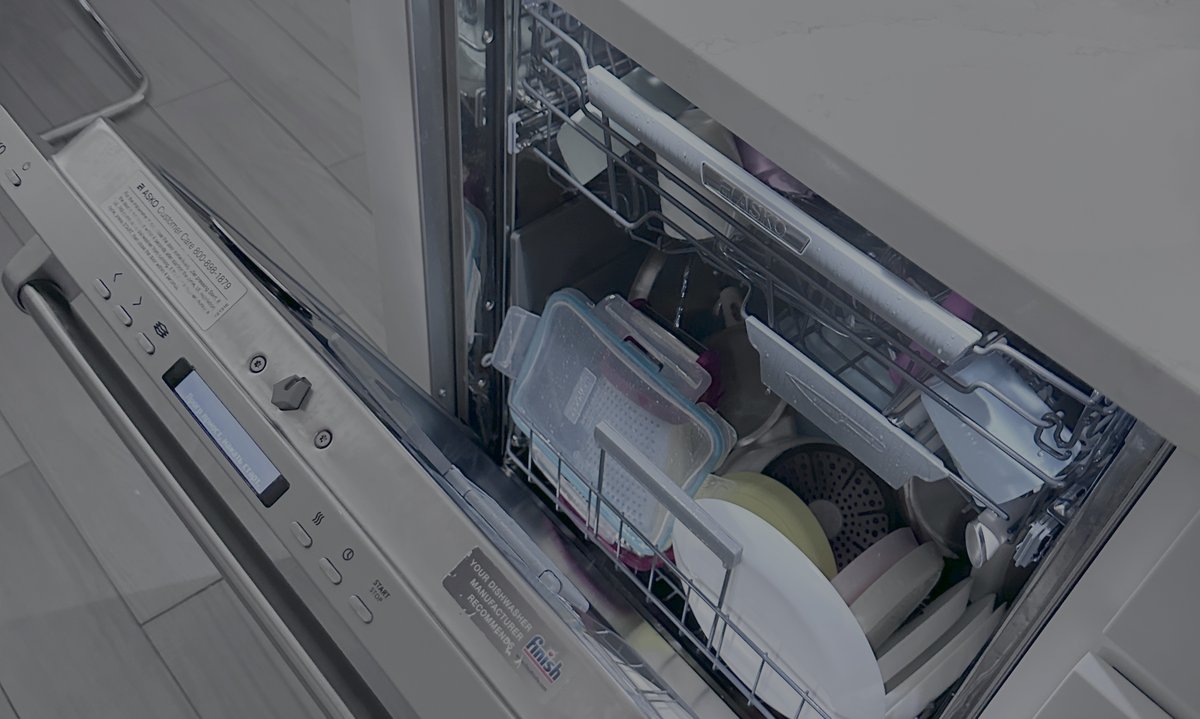
A large share of “my dishwasher isn’t cleaning” service calls in Denver turn out to be the filter. A clogged filter recirculates dirty water, redeposits food onto your dishes, smells, and eventually damages the circulation pump. The good news: filter cleaning is a 10-minute job, requires no tools, and costs nothing. The catch is that every brand puts the filter in a slightly different spot and uses different removal mechanics. This guide covers Bosch, Whirlpool/KitchenAid, Samsung, LG, GE, and Miele, plus the universal steps that apply to all of them.
Why the Filter Matters (90% Stat Explained)
Modern dishwashers use a fine-mesh filter to trap food particles so they don’t recirculate onto your dishes. Older US dishwashers ground food up with a hard-food disposer; almost every model sold after 2012 uses a filter instead because it’s quieter and more efficient. The trade-off is that the filter must be cleaned by the homeowner. Most manuals say monthly. Most homeowners never do it. Within 6–12 months you get film on glassware, grit in cup bottoms, a sour smell, and eventually a flashing error code as the pump struggles against the clog.
Cleaning Frequency — The Honest Answer
| Your Habit | Cleaning Frequency |
|---|---|
| Rinse plates first, run light loads | Every 6–8 weeks |
| Scrape only, run normal loads | Monthly |
| Don’t scrape, family of 4+, heavy loads | Every 2 weeks |
| After any single heavy load (oatmeal, mashed potato, casserole) | Immediately |
Universal Steps (Apply to All Brands)
- Pull the lower rack all the way out and set it on the counter.
- Locate the filter in the bottom-center of the tub.
- Twist counter-clockwise (or unlatch — brand specifics below) to remove.
- Rinse under warm running water while brushing gently with a soft brush.
- Inspect the sump well with a flashlight and remove any debris.
- Drop the filter back in and twist clockwise until it stops.
- Run a hot empty cycle with a dishwasher cleaning tablet to flush residue.
(Photo placeholders: a finger-twist on a Bosch filter, a Whirlpool two-piece filter assembly disassembled in the sink, a Miele filter showing the macro-filter and microfine combination.)
Brand-by-Brand Removal
Bosch / Thermador / Gaggenau (Same Filter Design)
Bosch dishwashers (and the Thermador and Gaggenau models built on the same platform) use a two-piece filter: a coarse cylinder on top of a fine micro-filter disc. Twist the cylinder counter-clockwise about 1/8 turn and lift straight up. The micro-filter disc underneath comes out by hand. Clean both pieces. Bosch’s filter is famously easy to remove but the micro-filter is often missed by owners — that’s the one that traps the fine particles and causes haze on glassware. For a deeper look at Bosch dishwashers, see our Bosch dishwasher repair page.
Whirlpool / KitchenAid / Maytag / JennAir (Same Filter Design)
Whirlpool-family dishwashers use a similar two-piece design. The upper cylinder twists counter-clockwise 1/4 turn; the lower flat filter lifts straight out by a tab. Important: on some KitchenAid models manufactured 2010–2015, the lower filter is held with an additional small clip — squeeze the tabs gently to release. The lower filter is fine mesh and clogs first.
Samsung
Samsung filters are a single one-piece assembly. Twist counter-clockwise (usually about 60°) and lift out. Some StormWash and Linear Wash models include a pre-filter screen on the floor of the tub — brush it off without removing. Samsung filters trap a lot of grease over time; let it soak in warm soapy water for 5 minutes for stubborn residue.
LG
LG uses a 3-part filter on many of its TrueSteam and QuadWash models: a top mesh ring, a middle cylinder, and a bottom fine filter. They unlock by twisting the top cylinder counter-clockwise; the bottom piece releases by hand. Rinse all three. LG filters tend to discolor (yellow-brown) over time — this is normal and not a defect.
GE / GE Profile / Cafe / Monogram
GE’s newer Ultrafresh and PDT dishwashers use a screw-out single filter. Twist counter-clockwise. Older GE units (pre-2018) may have a sealed self-cleaning filter — if you can’t see anything to twist, look up your model number. Self-cleaning models still benefit from quarterly checks of the sump for foreign objects (glass shards, fruit stickers).
Miele
Miele’s filter system is the most comprehensive of any brand: a triple-stage filter (coarse, macro, microfine) all combined in one removable unit. Twist counter-clockwise. Miele recommends cleaning every 50 cycles (roughly monthly in a family kitchen) and includes filter cleaning in their service maintenance schedule. The filter is robust but expensive to replace ($85–$140), so handle gently.
KitchenAid Older (Hard-Food Disposer Models)
Some pre-2012 KitchenAid models had a hard-food disposer instead of a filter. There’s nothing to remove or twist, but you should still check the sump for foreign objects and run a cleaning tablet monthly. Older disposer blades can dull, so if you hear grinding noises during the wash cycle, the disposer may need replacement.
What to Check While You’re In There
- The sump well — look for broken glass, fruit stickers, toothpicks, twist-ties. I find at least one of these on roughly every third service call.
- The lower spray arm jets — pop the arm off (twist or push the cap) and check for calcium deposits in the nozzle holes. Denver hard water clogs them fast.
- The door gasket — wipe with a microfiber cloth and a little white vinegar to kill mildew along the bottom seal.
After Cleaning: Run a Maintenance Cycle
Drop a dishwasher cleaning tablet (Affresh or Finish brand) into the detergent cup and run the hottest, longest cycle empty. This flushes loosened debris and dissolves any grease film in the pump and hose system. Do this monthly in addition to filter cleaning — it’s a 5-minute habit that prevents 80% of odor complaints.
Filter is clean but the dishes still come out gritty or filmy? The spray arms, water inlet valve, or circulation pump are the next suspects. Diagnosed and quote on the spot — usually same-day across Denver metro.
Frequently Asked Questions
How often should I clean my dishwasher filter?
Once a month at minimum, plus immediately after any heavy load with sticky residue (mashed potatoes, oatmeal, casseroles). Households that don’t pre-rinse should clean weekly.
Do all dishwashers have a removable filter?
Almost all post-2010 dishwashers do. Older units (and a few US-market Whirlpools through 2012) used self-cleaning hard-food disposers that don’t have a user-removable filter.
Why does my dishwasher smell even after cleaning the filter?
Check the spray arms, the door gasket, and the air gap. The filter is the most common source, but biofilm builds up in all three. Run a cycle with a dishwasher cleaner tablet monthly.
Can I put the filter in the dishwasher to clean it?
No. The filter needs manual brushing — biofilm and grease won’t come off in a normal cycle. Hot water and a soft brush at the sink takes 5 minutes.
My Bosch filter looks fine but the dishes still don’t clean. Now what?
Check the spray arm jets next — calcium from Denver hard water clogs them. After that, the water inlet valve, heating element, or circulation pump. See our dishwasher-not-cleaning guide.
Call Victor — Denver Dishwasher Service
Most Denver dishwasher complaints I see come down to filter or spray-arm clogs, and most of those are something you can clear yourself. When it’s deeper than that — pump, control board, water inlet valve — I handle dishwasher repair for every major brand including Bosch, Miele, Whirlpool, KitchenAid, Samsung, LG, and GE. Call (720) 447-8577 or book online.