Quick answer: A dryer that takes two or three cycles to dry one load is almost always choked by a restricted vent — that is the number one cause by a wide margin. Lint packs the duct, traps humid air, and clothes never fully dry. If the vent is clear, look next at dirty moisture sensors, a weak heating element, a failed cycling thermostat, or a blocked internal blower. Work the five checks below in order.
Likely Cause at a Glance
| Check | Symptom | DIY? | Fix Cost ($) |
|---|---|---|---|
| Vent restriction | Hot dryer, damp clothes, long cycles | Yes (30 min) | $0–$170 |
| Dirty moisture sensor | Auto cycles stop early or run long | Yes (10 min) | $0 |
| Weak heating element | Drum barely warm, no heat | No | $180–$280 |
| Failed cycling thermostat | Low heat, never gets fully hot | No | $150–$220 |
| Blower / drum restriction | Weak airflow at exhaust | No | $160–$300 |
Safety note: The U.S. Fire Administration and NFPA report more than 2,900 home dryer fires every year, causing roughly $35 million in property damage annually. The leading factor is failure to clean lint from the dryer and vent. A dryer that runs too long because of a clogged vent is also a dryer that is overheating — treat a long-cycle dryer as a safety issue, not just an annoyance. See the NFPA dryer safety page for full guidance.
Check 1: Clean the Vent (DIY, About 30 Minutes)
Start here before anything else. A restricted vent is by far the most common cause of long dry times on Denver service calls. The dryer works by blowing hot air through the wet clothes and pushing the resulting humid air out of the house through the duct. If that duct is packed with lint, the moist air has nowhere to go. It recirculates inside the drum, the humidity climbs, and clothes simply cannot dry no matter how long the cycle runs.
Here is how to clear the full vent run. Unplug the dryer (or shut off the gas). Pull it away from the wall and disconnect the flexible duct from the back of the machine and from the wall fitting. Vacuum lint out of the dryer's exhaust port, the entire length of duct, and the wall stub. Then go outside and check the exterior wall cap — lint and even bird nests collect behind the louvered flap. A long flexible vent brush makes this far easier on a longer run.
Two quick tests confirm a vent problem. First, run the dryer with the duct disconnected from the wall: if dry times return to normal, the duct or wall cap is your culprit. Second, go outside while the dryer runs and feel the airflow at the wall cap — it should be a strong, warm gust. A weak trickle means restriction. If your run is long, crushed behind the machine, or made of the old white vinyl duct, replacing it with smooth rigid metal duct is the best lasting fix. A professional vent cleaning in Denver runs $110–$170.
Check 2: Clean the Moisture Sensor Rods (Samsung Especially)
Modern dryers with an "Auto" or "Sensor Dry" cycle do not run on a timer — they stop when two thin metal strips inside the drum stop detecting moisture in the tumbling clothes. Those strips are the moisture sensor rods, and over time they get coated with a waxy film from dryer sheets and liquid fabric softener.
That film throws the reading off in both directions. A film bridge can make the dryer think clothes are still wet so it runs an extra long cycle, or it can fool the dryer into stopping early so you pull out damp laundry. Samsung dryers are notoriously sensitive to this — I see it constantly on Samsung models, and a wipe-down often resolves a "won't dry" complaint with zero parts.
The fix is free and takes ten minutes. Find the two metal strips, usually low on the drum opening or on the lint filter housing. Wipe them firmly with a cloth dampened in rubbing alcohol until the film is gone, then run a normal load. If auto cycles behave again, you are done. If they still misbehave, the sensor harness or control board may be at fault and needs a multimeter test.
Check 3: Heating Element Output ($180–$280)
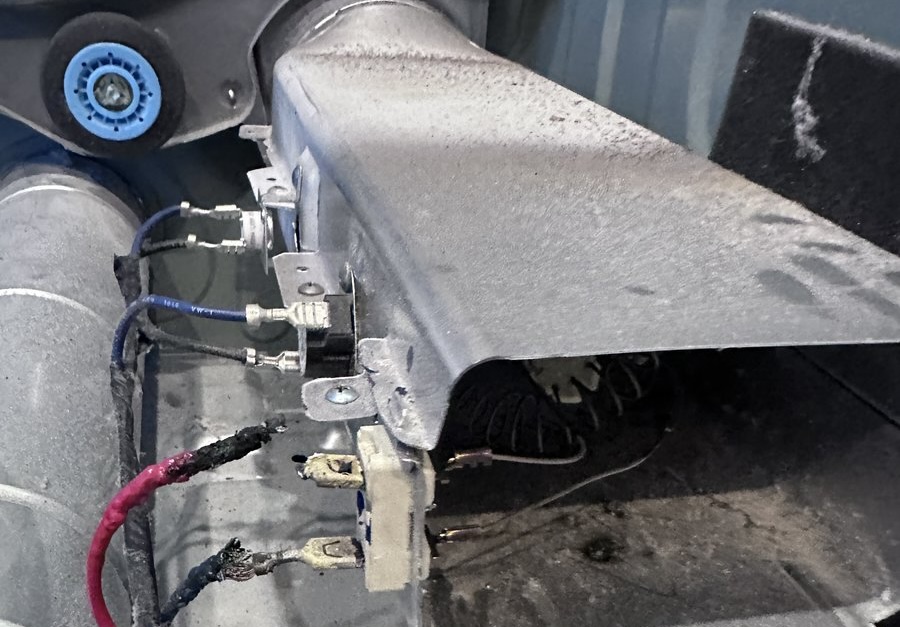
If the drum feels barely warm or cold to the touch during a cycle, the heating element is the prime suspect on an electric dryer. The element is a coiled wire that glows when current passes through it. Over years of heat cycling, a section of that coil can burn thin and partially open. The dryer still produces some heat, just not enough — so a load that should take 45 minutes drags on for 90 or more.
This is a technician-level job. Diagnosing it correctly means isolating the element from the thermal fuse and thermostats with a multimeter. A burned thermal fuse will also kill heat entirely, and a fuse blows for a reason — usually a restricted vent — so I always confirm airflow before replacing one. Installed cost for a heating element in Denver is $180–$280. If you have no heat at all rather than weak heat, our guide on a dryer not heating walks through the full diagnostic tree.
Check 4: Cycling Thermostat ($150–$220)
The cycling thermostat is a small disc-shaped switch mounted in the airflow path. Its job is to switch the heating element off when the air reaches the target temperature and back on when it cools, holding the drum in the correct range. When the cycling thermostat fails, it often opens too early or sticks at a low set point, so the element shuts down before the drum gets properly hot.
The symptom looks a lot like a weak heating element: low heat and long cycles. The difference is that with a bad thermostat the element itself tests fine, but the dryer never reaches full operating temperature. That is why both parts need a multimeter to tell apart — testing the thermostat's open and close behavior under heat is the only reliable check. A cycling thermostat replacement runs $150–$220 installed, and I carry the common ones on the truck so most are a single-visit fix.
Check 5: Drum Vent and Blower Restriction ($160–$300)
Airflow can be choked inside the cabinet, not just in the wall duct. Three internal spots collect lint and restrict flow. The first is the internal lint screen housing — the channel below the lint filter can pack solid with fine lint that the filter does not catch. The second is the blower wheel, the fan that actually moves air through the dryer; lint cakes onto the blades or a sock works past the drum and jams the wheel.
The third is the drum air seals. Felt seals at the front and rear of the drum keep air flowing the intended path. When they wear out, the dryer pulls room air through the gap instead of through the heater and clothes, so drying slows. Clearing the internal housing, cleaning or replacing the blower wheel, and renewing drum seals runs $160–$300 depending on the model. This check usually means partially disassembling the dryer, so it is best left to a technician.
What These Repairs Cost in Denver
| Repair | Parts + Labor | Time on Site |
|---|---|---|
| Professional vent cleaning | $110–$170 | 45–60 min |
| Moisture sensor cleaning | $0 (DIY) | 10 min |
| Heating element replacement | $180–$280 | 60–90 min |
| Cycling thermostat replacement | $150–$220 | 45–60 min |
| Blower wheel / drum seals | $160–$300 | 90–120 min |
| Thermal fuse replacement | $130–$200 | 45 min |
Every price includes the $75 diagnostic fee, which is waived when I do the repair. All repairs carry a 1-year warranty on parts and labor.
Need this fixed? Call (720) 447-8577. Service covers Denver, Highlands Ranch, Littleton, Centennial, Lone Tree, Englewood, Aurora, Parker, and Castle Rock. Same-day appointments are available most weekdays.
Frequently Asked Questions
Why does my dryer take two cycles to dry one load?
A restricted vent is the cause about 80% of the time. Lint builds up in the duct and wall cap, trapping the moist air inside the drum so clothes never fully dry. Clean the full vent run before replacing any parts.
Can a clogged dryer vent cause long dry times?
Yes. A vent clogged with lint cannot exhaust the humid air the dryer produces. Heat and moisture stay trapped in the drum, so a load that should take 45 minutes can take 90 minutes or more. It is also a serious fire hazard.
Why does the Samsung dryer run long even with a clean vent?
Samsung dryers are sensitive to a film buildup on the moisture sensor rods inside the drum. Dryer sheets and fabric softener coat the metal strips and trick the dryer into running extra cycles. Wipe the rods with rubbing alcohol every few months.
How much does it cost to fix a dryer that won't dry?
Vent cleaning runs $110 to $170 in Denver. A heating element is $180 to $280 installed, and a cycling thermostat is $150 to $220. The diagnostic visit confirms which part is at fault before any work begins.
Is a dryer that takes too long to dry a fire risk?
Yes. The NFPA reports more than 2,900 home dryer fires each year, and failure to clean lint from the vent is the leading cause. A dryer that runs long because of a clogged vent is overheating, so address it promptly.
Call Victor — Same-Day Dryer Repair in Denver
I’m Victor, EPA 608 Universal Certified with 7+ years on dryers of every brand. Easy Appliances Repair carries a 4.9 star rating across 128 Google reviews and offers a 1-year warranty on every repair. Book online or call (720) 447-8577 and I will be at your door — usually the same day — with the parts to fix it on the spot. See full dryer repair service details.